When Birth Is Treated Like an Emergency
For most of human history, birth happened at home. In communities. Surrounded by midwives and family members who had seen labor before, who understood its rhythms, and who knew how to wait.
Today, it mostly happens in hospitals.
And listen — hospitals are remarkable. When something goes wrong in pregnancy or labor, the people and equipment inside a hospital can save lives. That matters enormously. Nobody is arguing otherwise.
But here's the thing we need to talk about: most pregnancies aren't emergencies.
Most are healthy. Most are low risk. And yet millions of women give birth inside environments that were specifically designed around urgency, efficiency, and intervention.
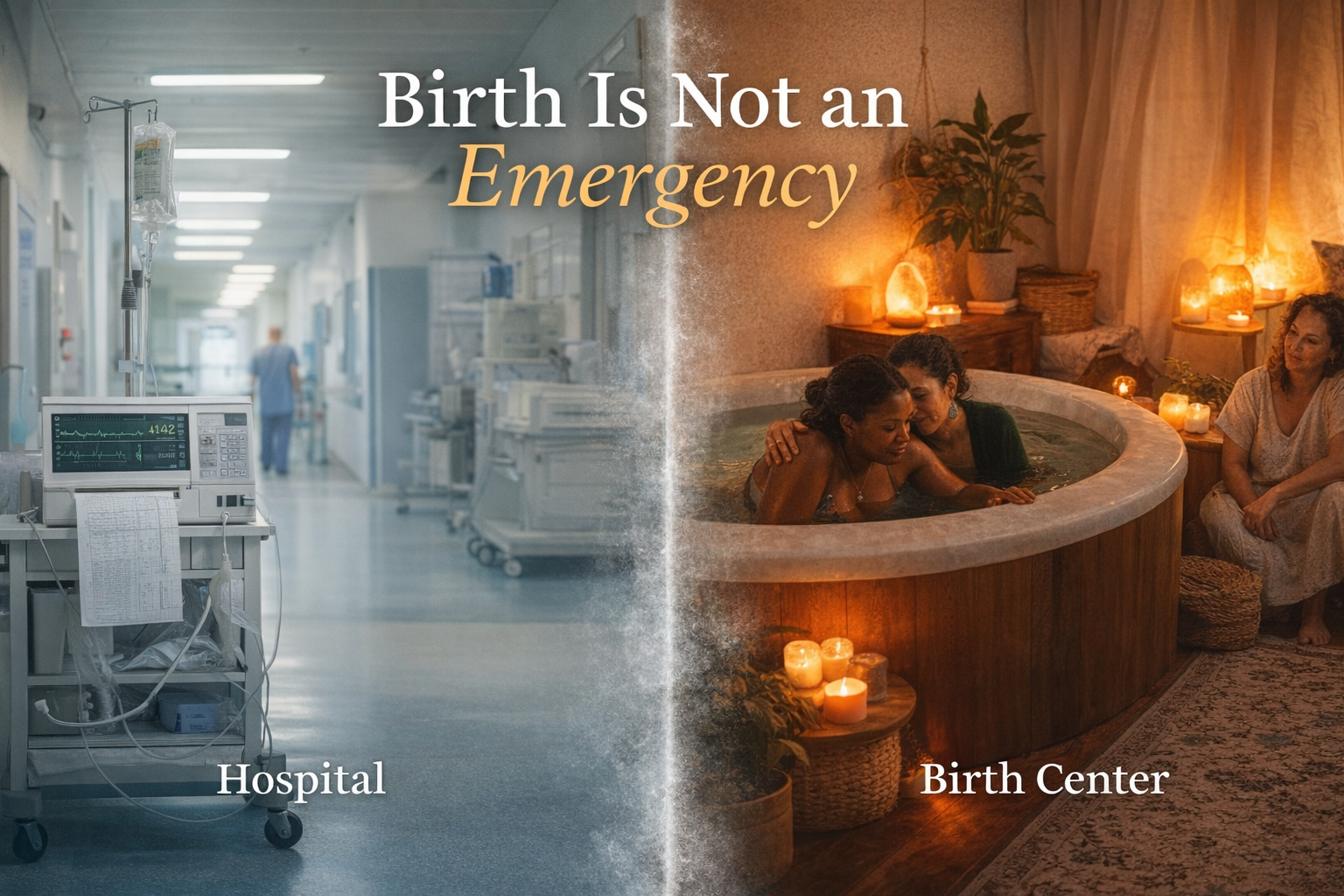
Hospital maternity units are built to catch complications quickly — which is exactly what you want when complications exist. But that same structure can shape the entire experience, even when everything is going well.
Labor gets timed.
Movement gets restricted.
Interventions can happen earlier than they might need to — not because anything is wrong, but because the environment is wired for what if something goes wrong.
For many women, that can lead to a birth experience that feels rushed. Or confusing. Or like something was happening to them rather than with them.
Families are starting to ask a fair question: does birth have to happen this way?
For low-risk pregnancies, research suggests that midwife-led birth centers can offer outcomes that are just as safe, with significantly lower rates of intervention. Responsible birth centers maintain transfer relationships with nearby hospitals, so if something changes during labor, higher levels of care are immediately available.
But the starting point is different.
Birth centers are built around the understanding that labor is a physiological process, not a medical problem.
You can move.
You can get in the water.
You can eat, rest, take your time, and have your support people around you.
The whole environment is designed around patience — which, it turns out, is often exactly what labor needs.
This isn't about rejecting medicine. It's about using medicine where it actually helps, rather than as the default setting for every birth regardless of risk.
At Lotus of Lakota Birthing Sanctuary, we believe families deserve real choices.
Hospitals will always be essential for high-risk pregnancies and emergencies. But for many healthy pregnancies, birth may unfold best in an environment designed to support the body — not just monitor it.
Birth isn't an illness.
And when you change the environment, you often change the experience of birth.
For most of human history, birth happened at home. In communities. Surrounded by midwives and family members who had seen labor before, who understood its rhythms, and who knew how to wait.
Today, it mostly happens in hospitals.
And listen — hospitals are remarkable. When something goes wrong in pregnancy or labor, the people and equipment inside a hospital can save lives. That matters enormously. Nobody is arguing otherwise.
But here's the thing we need to talk about: most pregnancies aren't emergencies.
Most are healthy. Most are low risk. And yet millions of women give birth inside environments that were specifically designed around urgency, efficiency, and intervention.
Hospital maternity units are built to catch complications quickly — which is exactly what you want when complications exist. But that same structure can shape the entire experience, even when everything is going well.
Labor gets timed.
Movement gets restricted.
Interventions can happen earlier than they might need to — not because anything is wrong, but because the environment is wired for what if something goes wrong.
For many women, that can lead to a birth experience that feels rushed. Or confusing. Or like something was happening to them rather than with them.
Families are starting to ask a fair question: does birth have to happen this way?
For low-risk pregnancies, research suggests that midwife-led birth centers can offer outcomes that are just as safe, with significantly lower rates of intervention. Responsible birth centers maintain transfer relationships with nearby hospitals, so if something changes during labor, higher levels of care are immediately available.
But the starting point is different.
Birth centers are built around the understanding that labor is a physiological process, not a medical problem.
You can move.
You can get in the water.
You can eat, rest, take your time, and have your support people around you.
The whole environment is designed around patience — which, it turns out, is often exactly what labor needs.
This isn't about rejecting medicine. It's about using medicine where it actually helps, rather than as the default setting for every birth regardless of risk.
At Lotus of Lakota Birthing Sanctuary, we believe families deserve real choices.
Hospitals will always be essential for high-risk pregnancies and emergencies. But for many healthy pregnancies, birth may unfold best in an environment designed to support the body — not just monitor it.
Birth isn't an illness.
And when you change the environment, you often change the experience of birth.